The names stay out. The evidence is there to be checked.
Every case on this site is built to be taken further by a newsroom: sources captured and fingerprinted, subjects anonymous, the trail checkable. This page is how to verify a case, republish one, or write for Lysey.
Request access or apply
For editors and journalists.
Thanks. Your message has reached Lysey.
Something went wrong. Please try again.
Who can use this, and why a work emailthe terms
Editors verifying a case, or journalists applying to write for Lysey. Use your professional email, your outlet's domain or your own, not a Gmail, Outlook or iCloud account. It is the simplest way to confirm you are who you say you are, and it keeps out people posing as an editor they are not. Messages go straight to Lysey. No email address is shown here, to keep the record clean. Your details are used to answer you, and your address also goes on the press list for case announcements; /unsubscribe takes it off. See the privacy statement.
For editors, in detail
What Lysey is, how it verifies, and how to write about it. Open what you need.
The source archiveverify later
Public sources cited in a case are captured the day they are read: Lysey's own dated screen capture and PDF, fingerprinted with SHA-256, and, where the archive accepts the page, a third-party Wayback Machine snapshot. The captures sit on the case pages themselves, behind the yellow capture buttons.
Live pages change and disappear; the archive does not. If a source has been edited or removed since publication, request the archived copy through the form above and check its fingerprint against the one published on the page.
What Lysey isthe record
Lysey is a documented investigation project. It documents cases: each is one case of a big company or a public institution failing an ordinary person, and each is built the slow way, from dates, screenshots, call notes, letters, and the actual paper trail.
One rule runs through all of it: Right is right. Wrong is wrong. Lysey publishes only what the evidence proves, holds itself to the same standard, and corrects itself when it is wrong. This is not a pile-on. It is a record.
The evidence standardverification
Nothing reaches a case on the strength of a claim alone. Every published case rests on primary documents that Lysey holds: correspondence, contracts, call notes, timestamps, the trail that a person kept while it happened. What appears in public is the verified account. The underlying material stays out of public view, to protect the person and to keep the record clean of anything that cannot be stood behind.
An editor or journalist working on a case can ask for the material behind it. Most of what a case rests on is already on its page. Beyond that there is no ready-made dossier waiting: name the document your piece needs and Lysey prepares and redacts that document for your request. Identifying detail is stripped before anything leaves here, and the subject is never identified without their explicit consent.
If a company respondsthe last word
A case runs only after the company has had a real chance to put it right. If a company answers, at any point, its answer is published on the case itself, in the sender's own words; the only edits are legal ones, and they are marked. Big organisations often stay silent. The door stays open regardless. If the evidence shows the organisation was in the right, Lysey says so, plainly and in the same place. The full standard, layer by layer, is on the method page.
You inherit that standard when you take a case further. Any right of reply you wish to extend, you can, with the documents in front of you.
Subject anonymitywhy
The people in these cases are private individuals who came forward against a party far larger than they are. Naming them would expose them to exactly the pressure the case exists to document, and it would deter the next person from coming forward at all. So the subject is never identified without their explicit consent, and identifying detail is stripped before anything is published.
Anonymity protects the person, not the story. The facts, the timeline, and the organisation's conduct are all on the record.
The larger party is described by what it did, not by rumour. Lysey does not invent detail to fill a gap.
If a case ever supports a collective or legal step, any wider sharing happens only with the person's explicit permission.
Questions of verification go through the form at the top.
Press kitname & mark
If you write about Lysey, here is how to get it right. All of this is free to use in coverage.
The name. Lysey, said LIE-see, rhyming with "icy". Lowercase in the wordmark, capitalised at the start of a sentence. Never all caps.
What it is, in one line. Lysey is a documented investigation project into how big companies and public institutions treat the ordinary people who depend on them.
The colours. Ink #0B0B0B, paper #F3F4F1, cobalt #2438FF, signal yellow #FFE600.
The pseudonym. Lysey is deliberately anonymous. Please don't speculate about who is behind it, the anonymity protects the people in the cases.
A short boilerplate you can copy: Lysey is a documented investigation project. It builds case by case from primary evidence, keeps the people in its cases anonymous, and holds to a single rule: Right is right. Wrong is wrong.
The mark. A cobalt baseline with a yellow caret above it, ready to write. The same caret blinks after the wordmark, cut down to a symbol that works as an avatar, an app icon or a favicon.
lysey
On ink
On paper
Mono / reversed
The wordmark. Set in Bricolage Grotesque at weight 800, tight tracking, always lowercase, followed by the yellow caret. The caret blinks in motion contexts and stays solid in print. Never all caps, never "LYSEY", never a full stop inside it.
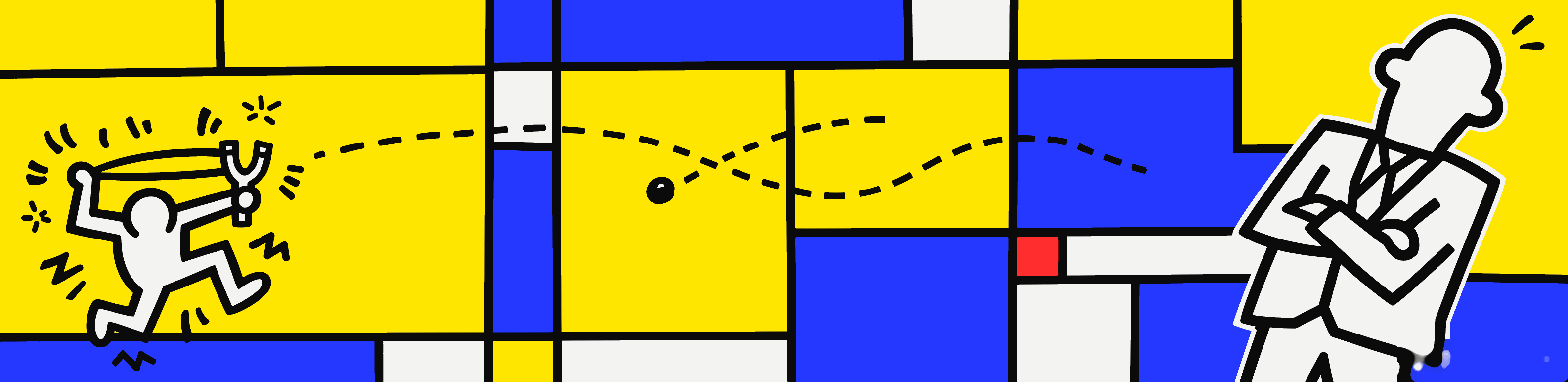
The artwork.Injustice, formed in art. Every case carries an original drawing. They are not decoration and not illustration of a news event: each one is a single wrong, held still, so it still reads years later. Flat vector, heavy black outline, faceless figures, four colours and no more. The figures have no faces because the case is not about a personality, and because the person it happened to stays anonymous. A drawing always freezes the moment the thing went wrong, never the moment it was put right, so a closed case looks exactly as unforgiving as an open one.
Using the artwork. Free to reproduce alongside coverage of a Lysey case, unaltered, credited to Lysey. Do not crop the figure out of the frame, do not recolour, do not add a logo. Higher resolutions on request through the form at the top.
Type. Three voices carry the identity.
Bricolage Grotesque · display, 800
Right is right. Wrong is wrong.
Newsreader · body serif, 400 / 500
Lysey documents case by case, from primary evidence, and keeps it on the record, put right or not.
Space Mono · labels & data, 400 / 700
META / APPLE · PUBLISHED 25-07-2026
Use it right.
✓ Do
Keep clear space around the mark of at least one caret width.
Use the mark in ink, paper or reversed, as shown above.
Keep the wordmark lowercase with the caret attached.
Let yellow mark one thing, not everything.
✗ Don't
Don't recolour, outline, stretch or rotate the mark.
Don't set the name in capitals or add a full stop inside it.
Don't place the mark on a busy background where it loses contrast.
Don't add effects, shadows or gradients.
Logo files (SVG and PNG) and a one-page fact sheet: editors and partners may request them through the form at the top.
Write for Lyseyfreelance
Lysey is looking for freelance investigative journalists to research and write cases: reporters who work from documents, hold the line on fairness, and would rather show than assert. If that is you, apply through the form at the top and show what you have done.
Lysey wants its cases read. You may republish a Lysey article in full, at no cost, as long as you credit it clearly as “Originally published by Lysey, lysey.com” with a link back, and keep the line stating that Lysey is a pseudonym and that the people in the case are anonymous. Republish it whole and unchanged, or quote from it; anything in between, ask first.


 Who can use this, and why a work emailthe terms